
Market diversification can be summarized in three critical stages: determining where to compete, how to compete, and how to win.
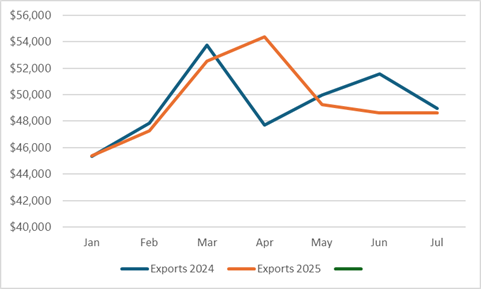
Recent trends (excluding April) point to a decline in U.S. exports to Asia. Beyond geopolitical tensions, persistent uncertainties, and punitive tariff rates, early signs of negative sentiment toward U.S. products may be emerging – similar to what Canada has already experienced.
For companies from other regions, this shift creates an opening to capture market share in a rapidly evolving, high-growth marketplace. For Canadian businesses in particular, with the CUSMA agreement scheduled for review in 2026, the uncertainty of a favorable outcome reinforces the urgency to strategically pivot toward ASEAN opportunities.
Figure 1, USA Exports to Asia 2025 versus 2025, source – Census.gov
Where to Compete
Where to compete means identifying the most promising opportunities by leveraging trade agreements, assessing economic potential, evaluating risk exposure, and weighing the probability of success – while also ensuring a positive contribution to people and society within those markets.
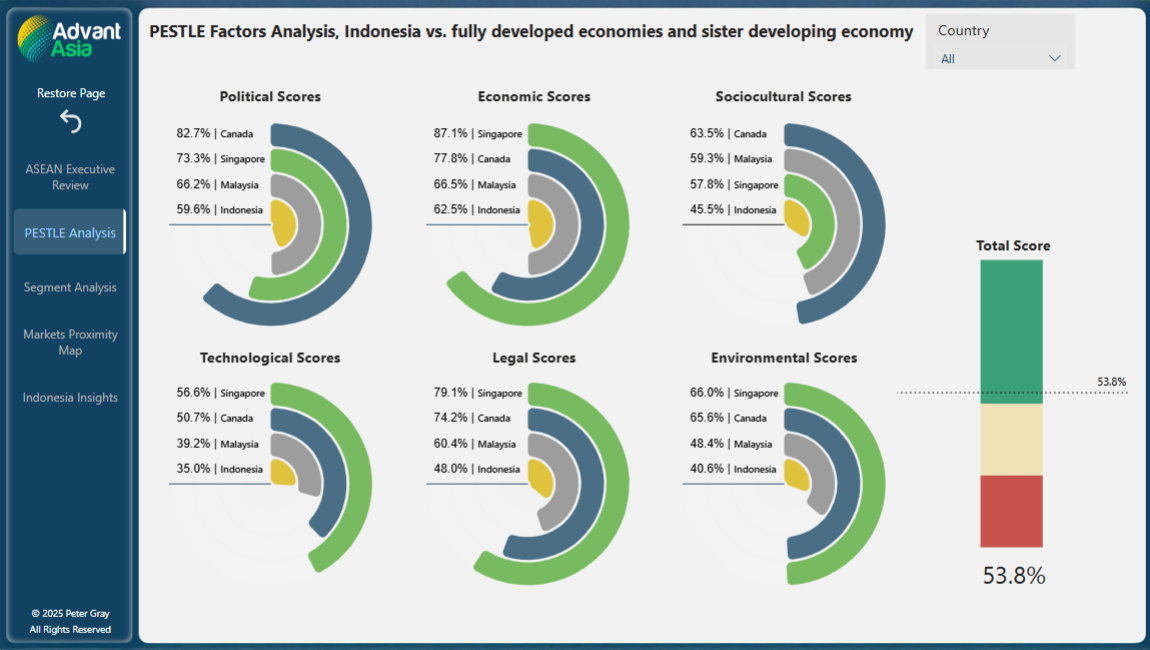
ASEAN is far from a homogeneous marketplace; in fact, it is one of the most ethnically, religiously, and linguistically diverse regions in the world. Each country under consideration therefore requires careful preliminary vetting. Tools such as AdvantAsia’s market intelligence reports that use PESTLE and SWOT analysis frameworks help qualify and quantify opportunities, ensuring that investment in in-market research and analysis is both justified and strategically sound.
Figure 2, AdvantAsia PESTLE Quantitative & Qualitative Framework
If a preliminary report confirms market viability, the next step is in-market analysis, often anchored around a strategically chosen trade show. This provides the opportunity to engage directly with potential customers and channel partners while gaining first-hand insights into the market environment.
Being on the ground allows you to appreciate the uniqueness of each market – identifying needs and gaps, begin building relationships, understanding compliance requirements, navigating local authorities (AHJs), evaluating risks, and mapping the competitive landscape.
A proven best practice is to extend your stay for at least a week after the trade show. Use this time to visit potential partner sites, meet prospects directly, and get a true sense of the market’s pulse and vibe. Often, the most valuable insights emerge not in formal sessions, but in the conversations shared during casual meetings and meals.
Finally, within the “where to compete” stage, a business self-assessment is essential to evaluate business and functional alignment with potential partners and customers, ease of accessibility, regulatory compliance, capabilities and capacity, and overall market positioning. By the end of your in-market visit, you should have a clear view of how effectively your organization aligns with local dynamics – and what adjustments are necessary to meet market-specific requirements.
How to Compete
Once the right market is identified, the focus shifts to strategy and execution: defining a clear value proposition, choosing go-to-market channels, setting pricing and positioning, and ensuring operational readiness. Budgets and resources should be treated as strategic levers, funding trade shows, capacity, compliance, partnerships, and staffing.
Success depends on trained, culturally aware teams and a balance between short-term wins and long-term scalability. In ASEAN, this means aligning people, processes, and resources with the region’s diversity, regulatory frameworks, and growth opportunities to achieve a sustainable competitive advantage.
How to Compete Framework for ASEAN (McKinsey 7S Framework Integrated)
- Strategy – Define a clear plan for market entry and growth: value proposition, go-to-market model, pricing, and long-term positioning, while maintaining agility and flexibility. A robust long-term strategy should outline a hierarchical approach to market development – progressing from exporting, to establishing regional sales representation, to setting up a representative office and bonded warehouse, and ultimately to FDI through acquisition or a greenfield project.
- Structure – Organize for success: establish reporting lines, regional representation, and partner management systems to support execution.
- Systems – Build the processes and tools required to support market entry: CRM platforms, compliance tracking, supply-chain visibility, and trade finance systems tailored to ASEAN operations. Leverage available funding and credit insurance programs through government and Crown corporations such as EDC (Export Development Canada) to strengthen financial resilience and mitigate risk.
- Shared Values – Ensure the company’s culture and values resonate with local stakeholders, emphasizing trust, sustainability, and long-term partnerships.
- Style – Adapt and unify leadership and management approaches to ASEAN’s relationship-driven business culture while maintaining strategic clarity.
- Staff – Empower both in-market and home-office employees with training, cultural awareness, and alignment to strategy.
- Skills – Leverage organizational capabilities – technical expertise, commercial know-how, and intercultural skills that create differentiation in competitive markets. Strengthen these competencies through trade education programs such as those offered by FITT (Forum for International Trade Training). As a priority, companies should ensure mastery of Incoterms, which form the foundation of international trade practices.
- Positioning & Pricing – ASEAN markets vary widely in their level of development and sophistication. Establish a clear market position that differentiates your offering from both local and international competitors. Keep in mind that product features and packaging may need to be adapted to local markets. Pricing strategies should account for local purchasing power, competitive dynamics, perceived value, and threshold of affordability – while maintaining profitability and alignment with your brand and company objectives. In ASEAN, flexibility is essential, and value-based pricing is often the most effective approach. (I will be publishing a follow-up article on strategic pricing in ASEAN.)
How to Win
Winning in ASEAN is not about making the first sale, but about earning recognition, trust, and preference among customers, partners, and stakeholders. Success requires consistent supply, cultural sensitivity, and long-term relationship building, not a one-size-fits-all approach.
The path from entry to leadership is anchored in four commercial pillars – Sales Enablement, Marketing, Business Development, and Branding – all reinforced by the McKinsey 7S framework to ensure alignment across strategy, structure, systems, staff, skills, style, and shared values.
Winning requires sustained focus on four commercial pillars, reinforced by the 7S framework:
Sales Enablement
- Systems – Deploy robust CRM, analytics, and sales automation tools to track opportunities and performance across multiple ASEAN markets.
- Skills – Equip teams and channel partners with intercultural selling skills, negotiation techniques, and market-specific product knowledge.
- Staff – Train and align both home-office and in-market personnel to work seamlessly with distributors and agents.
Marketing
- Strategy – Design campaigns that align with local buying behaviors, cultural nuances, and regulatory environments.
- Style – Adapt corporate messaging to resonate with ASEAN audiences while maintaining brand consistency.
- Shared Values – Emphasize themes of trust, sustainability, and long-term partnership in all marketing communications.
Business Development
- Structure – Build clear reporting lines and responsibilities for managing agents, distributors, and channel partners.
- Systems – Implement partner evaluation and compliance tracking processes to reduce risk and build confidence. Utilize lead management services that access prospects.
- Shared Values – Anchor business development in mutual growth, transparency, and long-term commitment.
Branding
- Style – Position company, leadership and teams as credible, consistent, and culturally aware in all customer interactions.
- Strategy – Progress the brand evolution from awareness → acceptance → preference → insistence, where customers actively demand your brand.
- Skills – Strengthen brand storytelling, thought leadership, and digital engagement capabilities.
Final Words
Market diversification is no longer optional – it is a strategic imperative. For Canadian companies, shifting focus toward ASEAN offers not only risk mitigation from CUSMA uncertainties, but also access some of the world’s fastest-growing economies.
The path forward is clear: determine where to compete, define how to compete, and execute on how to win. With disciplined analysis, aligned resources, and focus on the four commercial pillars – all underpinned by the McKinsey 7S framework – companies can move beyond exploration to establish sustainable, scalable, and profitable positions in ASEAN.
Winning in ASEAN requires more than presence. It requires preparation, persistence, patience, and partnerships (more P’s to add to the P-bucket). Companies that commit to these principles will not just enter the market – they will lead it.
“My intention is not to oversimplify a complex and challenging process, but to provide clarity on the essential steps to success in entering and developing ASEAN. My approach and insights are drawn from my 20+ years of in-market experience, reinforced by an MA in International Relations (Economy & Trade), an MBA in Strategic International Marketing, and a CITP designation (FITT)”.