

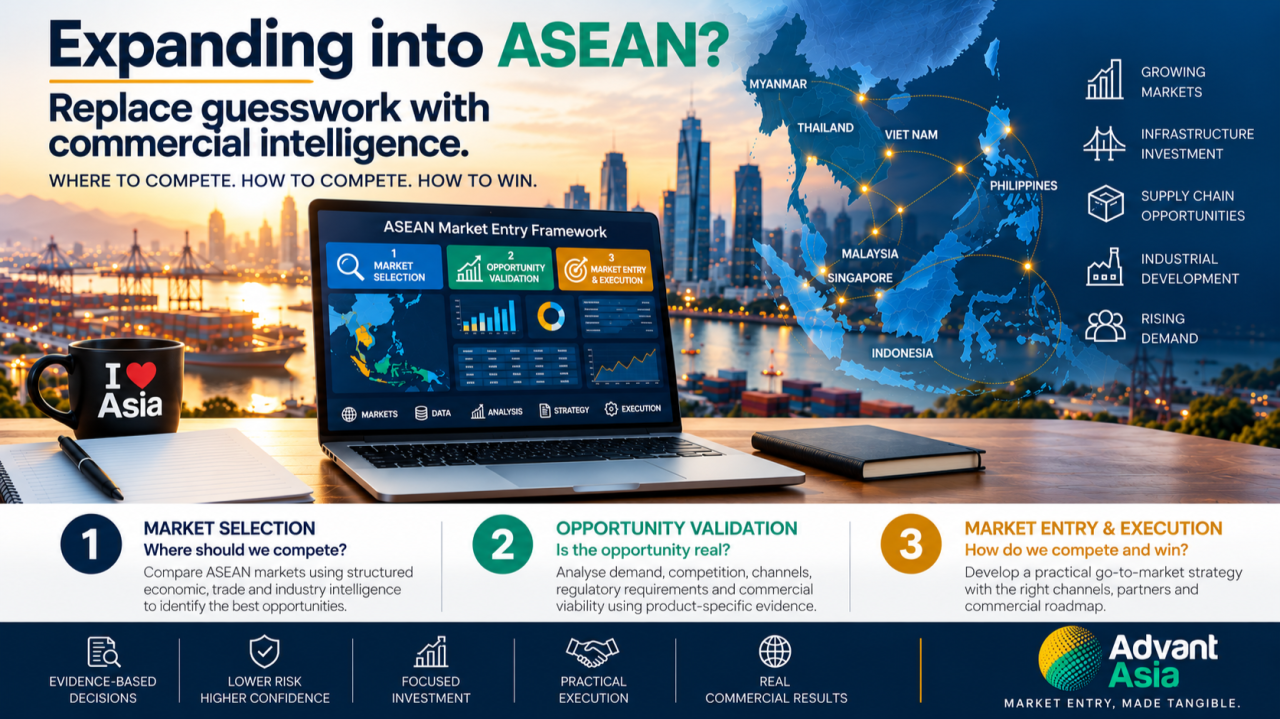
Expanding into ASEAN? Replace Market-Entry Guesswork with Commercial Intelligence
Where to compete. How to compete. How to win.
For Canadian companies considering international expansion, the Asia-Pacific region, particularly the rapidly developing markets of ASEAN, offers significant commercial opportunities.
Growing populations, industrial development, infrastructure investment, expanding manufacturing capabilities and evolving supply chains are creating opportunities across a broad range of industries.
But opportunity does not automatically translate into commercial success.
One of the most common mistakes companies make when considering international expansion is confusing market potential with market opportunity.
A country may have impressive economic growth, a large population or substantial infrastructure investment. None of these factors independently establishes whether a particular product or service can compete successfully in that market.
The real questions are more specific:
- Which markets offer the strongest commercial potential for our products?
- Is there sufficient demand to justify investment?
- Who are the competitors, and how are they positioned?
- What barriers, risks and costs must we overcome?
- Which distribution and market-entry channels are most appropriate and effective?
- Can we establish a competitive, profitable, sustainable and scalable market position?
These are not questions that should be answered through assumptions, anecdotal information or generic market reports.
They require a structured, evidence-based approach to market selection, opportunity validation and commercial execution.
Experience Matters. Evidence Matters More.
Having spent approximately two decades living and working in Singapore, with extensive commercial responsibilities across Southeast Asia, China, Taiwan and Australia, I have experienced firsthand the opportunities and complexities of doing business throughout the region.
One lesson has remained consistent.
International market entry is rarely unsuccessful because companies lack ambition. More often, they underestimate the importance of market intelligence, commercial validation and disciplined execution. Ambitions must align with abilities.
A promising conversation with a prospective distributor does not constitute market validation.
A favourable economic forecast does not establish demand for your product.
And identifying an attractive market does not mean your company has the capabilities, resources or commercial positioning required to succeed.
This is why we developed a structured market-entry framework at AdvantAsia Strategy.
Our objective is straightforward: help companies make better international expansion decisions before committing significant financial and organizational resources.
A Practical Three-Step Framework for International Market Entry
At AdvantAsia Strategy, we approach international expansion through three connected stages.
Each addresses a different commercial question and provides a foundation for the next decision.
Step 1 – Market Screening & Selection
Where should we compete?
The first challenge is identifying which markets deserve management attention and investment.
ASEAN is not a single homogeneous market. Indonesia, Viet Nam, Thailand, Malaysia, the Philippines and Singapore differ considerably in their economic structures, industrial development, regulatory environments, social and cultural considerations, competitive landscapes and distribution systems.
Treating these markets as interchangeable can lead to costly mistakes, some of which may be difficult to reverse.
Our market-screening methodology combines structured economic, trade, investment and operating-environment intelligence to compare markets using consistent criteria.
Depending on the industry and product category, this can include:
- Economic and industrial development indicators.
- International trade flows and import dependence.
- Capital investment and infrastructure activity.
- Political, economic, social, technological, legal and environmental considerations.
- Market accessibility and commercial risk.
- Industry-specific demand indicators.
We translate this information into comparative intelligence dashboards that help companies identify relative market attractiveness.
What does the client gain?
A clearer understanding of which markets warrant further investigation, which present greater risks and where commercial resources should be concentrated.
Equally important, companies can identify markets that should not be prioritized.
Market screening is not intended to prove that an opportunity exists. It is designed to determine where deeper investigation is justified.
Step 2 – Opportunity Validation
Is the opportunity real?
Once priority markets have been identified, the next challenge is establishing whether a commercially viable opportunity actually exists.
This requires moving beyond macroeconomic indicators into product- and industry-specific intelligence.
Depending on the engagement, our investigation examines:
- Market demand and consumption indicators.
- Import and domestic production activity.
- Competitive products, suppliers and market positioning.
- Customer segments and purchasing behaviour.
- Distribution structures and potential channel partners.
- Regulatory and technical requirements.
- Pricing, costs and potential commercial margins.
An important distinction must be made between information that is independently verified, information derived from reasonable assumptions and information that remains unavailable.
Not all market intelligence is equally reliable.
For example, broad import statistics may indicate significant trade activity, but they do not necessarily establish demand for a specific product.
Similarly, identifying a distributor does not confirm that the distributor has the technical capability, customer relationships or commercial motivation required to develop your business.
Our approach is to distinguish verified market evidence from assumptions and identify the information gaps that could materially influence an investment decision.
What does the client gain?
A more defensible assessment of commercial opportunity, competitive positioning, market-entry requirements and potential constraints.
This stage helps management determine whether to proceed, reconsider the market or investigate further before committing resources.
Sometimes the most valuable outcome is identifying an opportunity that does not justify investment.
Step 3 – Market Entry & Go-to-Market Execution
How do we compete and win?
Identifying an attractive market and validating demand are important achievements.
But neither generates revenue.
Successful international expansion ultimately depends on converting market intelligence into commercial execution.
This is where practical experience becomes particularly important.
Our market-entry and go-to-market work focuses on translating research findings into actionable commercial decisions.
This may include:
- Market-entry strategy and operating model.
- Distributor, agent, direct-sales or hybrid channel evaluation.
- Target customer identification and prioritization.
- Competitive differentiation and value proposition development.
- Strategic pricing and commercial positioning.
- Partner qualification and engagement.
- Sales development priorities.
- Implementation planning, milestones and performance measures.
The objective is not simply to produce another strategy document.
It is to establish a practical commercial roadmap that management can implement, monitor and refine.
What does the client gain?
A defined route to market, clearer commercial priorities, a more disciplined approach to channel development and a framework for measuring progress against clearly defined business objectives.
Execution is where market intelligence becomes commercially valuable.
Making Market Intelligence More Accessible
Traditionally, international market-entry consulting has often involved lengthy research projects, substantial consulting fees and static reports.
For many small and medium-sized companies, particularly those exploring international markets for the first time, this creates a significant barrier.
We believe the delivery model can be improved.
At AdvantAsia Strategy, we combine international commercial experience with digital assessment tools, interactive dashboards and AI-assisted research capabilities.
This allows us to structure complex information, improve consistency, visualize market comparisons and make strategic assessments more accessible.
Our approach is designed to provide clients with tangible outputs they can understand, challenge and use.
However, technology alone does not create sound commercial strategy.
AI can accelerate research, organize information and identify patterns. It cannot independently replace the experience required to interpret market conditions, assess commercial relationships or make practical investment decisions.
Artificial Intelligence still needs Actual Intelligence.
Technology enables. Experience differentiates.
What Should Companies Expect from a Market-Entry Advisor?
Before engaging an advisor, companies should understand what they are buying.
A market-entry assessment should deliver more than an attractive presentation or a list of potential distributors.
It should provide greater clarity around the decisions management needs to make.
At a minimum, companies should expect:
Transparency: A clear distinction between verified facts, estimates, assumptions and information gaps.
Relevance: Intelligence directly connected to the company’s products, capabilities and commercial objectives.
Comparability: A consistent framework for evaluating alternative markets and opportunities.
Commercial judgment: Interpretation that connects research findings to realistic market-entry decisions.
Actionability: Recommendations that identify what should happen next, why it matters and what resources may be required.
Realistic expectations: Recognition that market intelligence reduces uncertainty but does not eliminate commercial risk or guarantee success.
Ultimately, the value of market-entry advisory services should be measured by their contribution to better decisions, more focused investment and stronger execution.
Clarity Before Commitment
International expansion can create substantial opportunities for Canadian manufacturers, technology providers and other growth-focused businesses.
But entering a new market is not simply a sales initiative.
It is a strategic investment involving capital, management attention, organizational capabilities and commercial risk.
The objective should not be to enter as many markets as possible.
It should be to identify the right markets, validate the right opportunities and develop the capabilities necessary to compete successfully.
That requires a disciplined progression:
Market Screening → Opportunity Validation → Market Entry & Execution
At AdvantAsia Strategy, we call this approach:
Market Entry, Made Tangible.
We help companies move from assumptions to evidence, from market potential to validated opportunity, and from strategic intention to commercial execution.
Because successful international expansion begins with knowing where to compete, how to compete and how to win.
Investigate before you invest.
About AdvantAsia Strategy
AdvantAsia Strategy is an international market-entry advisory practice specializing in Asia-Pacific and ASEAN market intelligence, commercial strategy and go-to-market execution.
Drawing on more than 25 years of international commercial leadership and extensive experience living and working throughout Asia-Pacific, we help Canadian and international companies evaluate opportunities, manage market-entry risks and develop practical expansion strategies.
Our approach combines commercial experience, structured market intelligence, digital assessment tools and actionable strategy development.
AdvantAsia Strategy | Where to compete. How to compete. How to win.